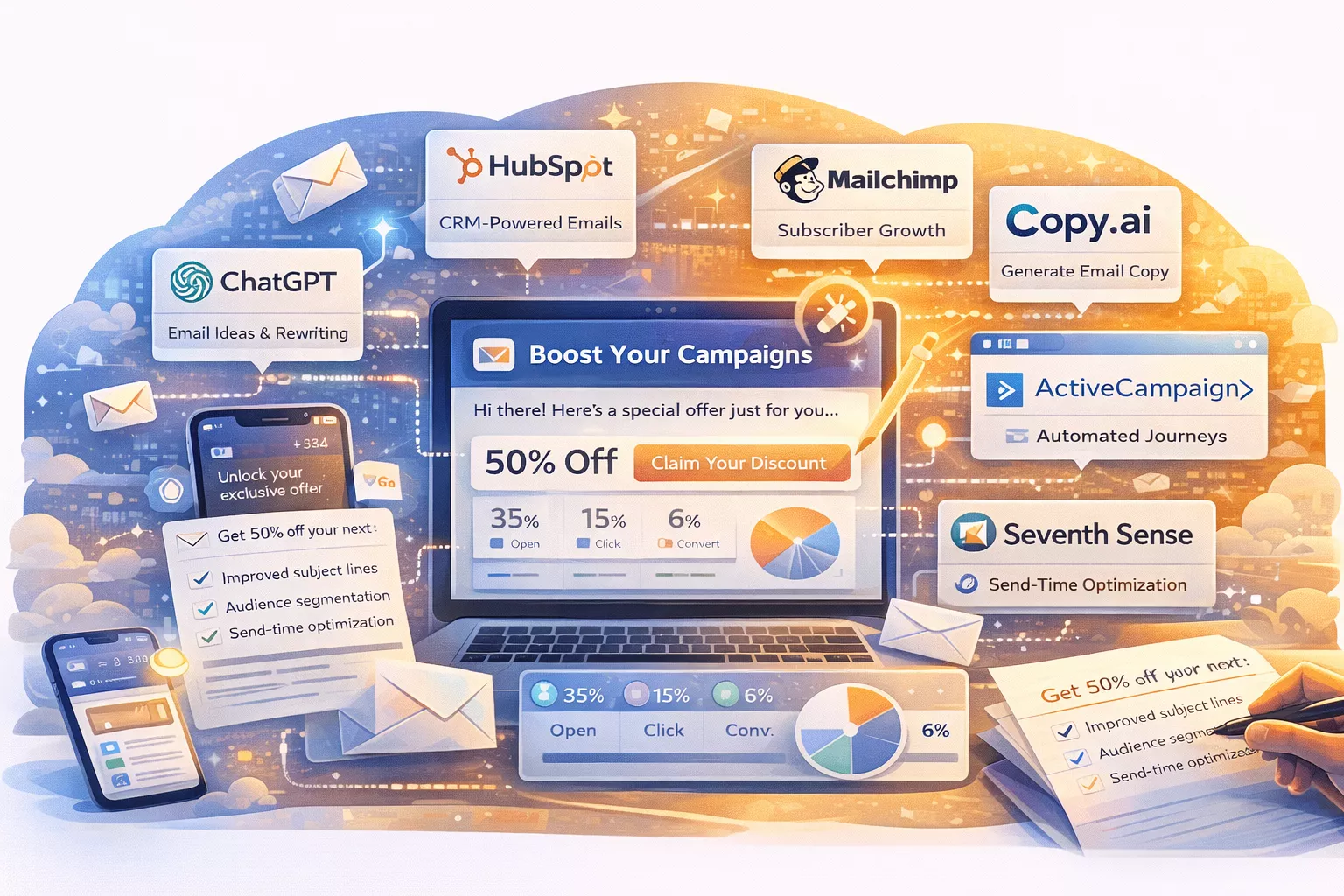
Email marketing remains one of the highest-ROI digital channels, but standing out in crowded inboxes now requires speed, personalization, and data-driven optimization. In 2026, AI tools play a critical role in helping marketers write better emails, personalize at scale, optimize subject lines, automate journeys, and improve deliverability.
This guide covers the best AI tools for email marketing in 2026, what they’re best at, and how to choose the right mix based on your goals and team size.
Why AI Is Essential for Email Marketing in 2026
Modern email marketing goes far beyond sending newsletters. Marketers are expected to:
- Personalize content for different segments
- Optimize subject lines and CTAs for opens and clicks
- Automate lifecycle and behavior-based campaigns
- Continuously test and improve performance
AI helps by reducing manual effort and using data to guide decisions — from what to send, to who to send it to, and when.
Best AI Tools for Email Marketing in 2026
1) HubSpot Email Marketing (with AI)
Best for: End-to-end email marketing with CRM data.
HubSpot integrates AI directly into email creation, personalization, and automation. Marketers can generate subject lines, draft copy, personalize emails using CRM fields, and optimize campaigns based on engagement data.
- Pros: Deep CRM integration; strong automation; scalable
- Cons: Higher cost as contact volume grows
2) Mailchimp
Best for: SMB email campaigns with AI optimization.
Mailchimp uses AI to recommend send times, generate subject lines, and optimize content. It’s widely used by small to mid-sized businesses looking for ease of use with smart automation.
- Pros: Easy setup; good AI recommendations; broad adoption
- Cons: Limited flexibility at lower tiers
3) ActiveCampaign
Best for: AI-driven automation and lifecycle emails.
ActiveCampaign combines email marketing with powerful automation and behavioral targeting. Its AI features help optimize timing, personalize messaging, and predict engagement.
- Pros: Advanced automation; strong segmentation
- Cons: Steeper learning curve
4) Copy.ai
Best for: Writing email copy and subject lines.
Copy.ai is commonly used to generate email drafts, cold outreach messages, follow-ups, and subject line variations. It’s especially useful for teams that already have an ESP but want better copy faster.
- Pros: Fast copy generation; strong templates
- Cons: No native sending or analytics
5) ChatGPT
Best for: Strategy, personalization ideas, and copy refinement.
ChatGPT is widely used to brainstorm campaign ideas, rewrite emails for tone, personalize outreach, and generate A/B test variations. It works best when paired with an email platform.
- Pros: Highly flexible; great for ideation and rewriting
- Cons: Requires manual integration into workflows
6) Phrasee
Best for: AI-optimized subject lines and CTAs.
Phrasee specializes in generating and optimizing language for email subject lines, push notifications, and CTAs based on performance data.
- Pros: Strong performance focus; data-driven language
- Cons: Narrow use case; enterprise-leaning pricing
7) Seventh Sense
Best for: AI send-time optimization.
Seventh Sense analyzes recipient behavior to determine the best time to send emails for each individual contact — improving open and engagement rates.
- Pros: Improves deliverability and opens
- Cons: Requires integration with HubSpot or Marketo
How to Choose the Right AI Email Marketing Tool
Creation vs optimization vs automation
- Copy creation: AI writing tools (ChatGPT, Copy.ai)
- Campaign optimization: Tools like Phrasee and Seventh Sense
- Full-stack email marketing: Platforms like HubSpot or ActiveCampaign
Consider your email volume and complexity
High-volume senders and B2B teams benefit most from AI-driven automation and personalization, while smaller teams may only need AI copy support.
Best Practices for Using AI in Email Marketing
- Use AI to accelerate drafting, not replace strategy
- Always review copy for brand voice and compliance
- Combine AI personalization with real customer data
- Test AI-generated variations continuously
Conclusion
The best AI tools for email marketing in 2026 help marketers write better emails, personalize at scale, and continuously improve performance. Whether you’re running simple newsletters or complex lifecycle campaigns, AI can remove bottlenecks and unlock higher engagement.
For most teams, the ideal setup combines an AI-powered email platform with a flexible AI writing assistant — ensuring both operational efficiency and creative control.